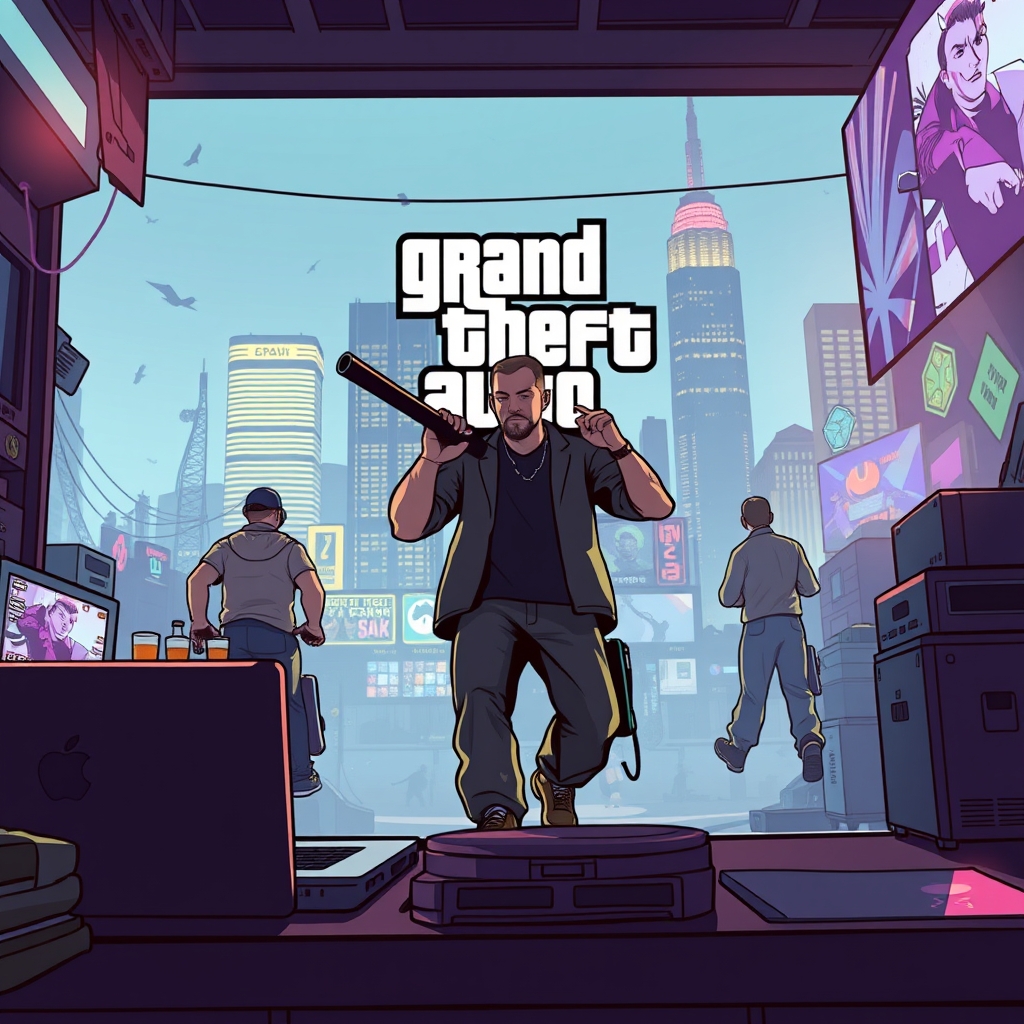
Rockstar: Next Game After GTA 6 Won’t Take 8 Years to Make
Rockstar Confirms the Next Game After GTA 6 Will Not Take Eight Years
For more than a decade, the gaming world has lived under a simple, frustrating reality: masterclasses in open-world game design take an absurdly long time to build. When Grand Theft Auto V launched in September 2013, the PlayStation 4 and Xbox One were not even on store shelves yet. By the time Grand Theft Auto VI finally lands in the hands of players worldwide, an entire generation of hardware will have come and gone. Fans have grown accustomed to waiting anywhere from five to twelve years for Rockstar Games to release a brand-new title.
However, that grueling cycle might finally be coming to an end. According to reports stemming from recent executive comments highlighted by Video Games Chronicle, Rockstar Games and its parent company, Take-Two Interactive, have signaled that the title following Grand Theft Auto 6 will not require another eight-year development marathon. For millions of gamers who feared they might only see two or three more Rockstar titles in their entire adult lives, this statement brings a massive sigh of relief.
At TechRook, we follow both the software engineering and the business dynamics driving modern entertainment. Producing modern digital universes has pushed the industry to its absolute limits. Below, we break down why Rockstar made this ambitious claim, how their production pipelines are changing, what tools are speeding up their workflow, and what this means for the future of interactive entertainment.
The Evolution of Rockstar’s Release Timeline
To understand why this news is so monumental, it helps to look back at how Rockstar Games used to operate. During the PlayStation 2 era, the studio was an absolute powerhouse of rapid-fire releases. Between 2001 and 2008, Rockstar published multiple genre-defining titles across several distinct franchises.
Consider the sheer volume of their output during those golden years:
- Grand Theft Auto III (2001): Introduced the modern 3D open-world genre.
- Grand Theft Auto: Vice City (2002): Delivered just one year later with an iconic 1980s aesthetic and fully voiced protagonist.
- Grand Theft Auto: San Andreas (2004): Expanded the map to an entire state featuring three major cities, RPG mechanics, and unprecedented freedom.
- Bully (2006): A fresh, narrative-driven schoolyard adventure.
- Grand Theft Auto IV (2008): A technological leap forward into high-definition physics and complex storytelling.
In that era, a brand-new, world-class experience arrived every one to two years. However, as gaming hardware grew more complex, the requirements for photorealistic graphics, intricate physics, and vast voice-acted scripts exploded. Development teams ballooned from dozens of developers to thousands of specialized professionals spread across continents.
| Game Title | Release Year | Gap From Previous Major Game |
|---|---|---|
| Grand Theft Auto IV | 2008 | N/A (Beginning of HD Era) |
| Red Dead Redemption | 2010 | 2 Years |
| Grand Theft Auto V | 2013 | 3 Years |
| Red Dead Redemption 2 | 2018 | 5 Years |
| Grand Theft Auto VI | Scheduled / Anticipated | 7+ Years (since RDR2) / 12+ Years (since GTA V) |
As shown in the table above, the gap between major releases widened dramatically after 2013. The transition from Grand Theft Auto V to Red Dead Redemption 2 took five years, and the wait between Red Dead Redemption 2 and Grand Theft Auto VI has stretched even further. The promise that the next project will not take another eight years represents a deliberate reversal of this historical trend.
Why Did Development Cycles Become So Painfully Long?
The ballooning timelines were not caused by laziness or lack of funding. Rockstar Games possesses virtually unlimited financial resources, backed by the continuous revenue engine of GTA Online. Instead, three distinct bottlenecks stretched these development schedules to historic lengths.
1. Unprecedented Scope and Technological Ambition
Rockstar does not just build game maps; they build functioning digital ecosystems. Red Dead Redemption 2 set a benchmark that very few studios have dared to match. Every non-player character (NPC) possessed an independent daily schedule, custom dialogue trees, dynamic memory of player interactions, and individual reaction states. Animals hunted, scavenged, and interacted realistically without player intervention. Achieving that level of fidelity required millions of lines of custom code, countless motion-capture sessions, and painstaking testing.
2. Overhauling Studio Culture and Eradicating Crunch
Following the release of Red Dead Redemption 2 in 2018, extensive investigative reports exposed extreme workplace stress, colloquially known as crunch culture, inside Rockstar’s studios. Employees reported working 70 to 80-hour workweeks to finish projects on time. Recognizing the human and reputational cost, Rockstar management undertook an extensive internal restructuring.
They eliminated mandatory overtime, improved management communication, replaced problematic team leads, and adopted sustainable scheduling. While these changes created a much healthier working environment for staff, the transition naturally extended production timelines for upcoming projects, including GTA 6. Building games ethically takes longer when you refuse to run your workforce into the ground.
3. The Global Disruptions of 2020
Like every other major technology enterprise, Rockstar had to navigate the sudden shift to remote work during the 2020 global pandemic. Game development, particularly at Rockstar’s scale, relies heavily on secure on-site server architecture, shared motion-capture stages, and collaborative in-person playtesting. Transitioning thousands of employees to decentralized home setups caused friction across the entire games industry, adding at least a year or two to high-profile schedules.
How Rockstar Plans to Shorten the Gap After GTA 6
Saying a game will not take eight years is easy. Actually delivering on that promise within an industry plagued by constant delays requires radical operational adjustments. Take-Two Interactive and Rockstar leadership have pointed toward several foundational shifts that will make faster delivery possible.
Unified Global Studios
Historically, individual Rockstar studios often operated as semi-autonomous entities with specific assignments. Rockstar North handled Grand Theft Auto, Rockstar San Diego managed Red Dead Redemption, and Rockstar New England assisted with various secondary elements. Over the last several years, Rockstar completed an internal initiative to unite all its worldwide studios into a single, cohesive development entity.
Today, artists, programmers, and designers in the United Kingdom, the United States, India, and Canada share unified asset libraries, identical project management frameworks, and coordinated codebases. This global synchronization allows work on a title to continue virtually around the clock. When a development team in North America clocks out for the day, teams in other time zones can pick up the mantle without losing critical momentum.
A Mature, Iterative RAGE Engine
Rockstar builds its games on the proprietary Rockstar Advanced Game Engine (RAGE). A massive portion of the development time for Red Dead Redemption 2 and GTA 6 involved rewriting core components of this engine to handle next-generation lighting, advanced volumetric clouds, modern artificial intelligence, high-speed vehicle physics, and dense urban populations.
Once Grand Theft Auto VI is finalized, the RAGE engine will sit at peak maturity. The studio will not need to reinvent the wheel for its next project. Instead of spending several years constructing core tools, rendering pipelines, and physics interactions from scratch, engineers can immediately pivot toward world design, storytelling, and mission scripting using an established, battle-tested toolset.
Smarter Pre-Production and Scoping
One of the quiet killers of game development efficiency is feature creep, where creative directors add new mechanics, expand map boundaries, or discard months of work deep into production. Reports indicate that Rockstar has dramatically refined its pre-production process.
By locking down storylines, mechanics, and design philosophies before full-scale engineering commences, the studio avoids costly rewrites and discarded assets. The vision for the next title will likely be codified long before GTA 6 even completes its final patch cycle.
Modular Live Content Integration
Rockstar has learned valuable lessons from GTA Online. Rather than trying to cram every conceivable idea, minigame, and concept into a physical release on day one, modern production pipelines favor modular expansion. The studio can launch a complete, narrative-rich, mechanically polished core game, and then steadily inject expanded territories, secondary gameplay mechanics, and new narrative arcs through regular online updates. This modularity reduces upfront production pressure while ensuring titles hit store shelves on a predictable timeline.
What Could the Next Game Actually Be?
Assuming Rockstar successfully avoids another eight-year drought, what project will follow Grand Theft Auto 6? While the studio remains famously secretive, industry observers and long-time fans point to a handful of distinct possibilities.
1. Red Dead Redemption 3
The Red Dead franchise stands proudly alongside Grand Theft Auto as Take-Two’s most profitable and critically acclaimed intellectual property. With Red Dead Redemption 2 surpassing 60 million copies sold worldwide, an eventual third installment is practically guaranteed. Whether the story returns to the Van der Linde gang during their formative years or introduces an entirely new cast of frontier outlaws, the historical Western genre remains fertile ground for Rockstar’s narrative prowess.
2. A Long-Awaited Return to Bully
Few titles command a more loyal cult following than Bully (known as Canis Canem Edit in select European regions). For years, rumors have swirled regarding canceled prototypes and early script drafts for a sequel. A modern take on an educational academy, focusing on satire, youthful rebellion, and compact open-world design, would provide a welcome contrast to the sprawling scale of modern GTA titles. Because a project like Bully 2 would feature a smaller geographic footprint, Rockstar could comfortably produce and polish it within a four to five-year window.
3. A Brand-New Intellectual Property
Rockstar has not launched an entirely new original intellectual property since L.A. Noire in 2011 (which was primarily developed by Team Bondi) or Table Tennis in 2006. Many veteran developers inside the company may relish the creative freedom to construct a brand-new universe unburdened by twenty years of established lore. Rumors of a historical medieval project or a hard sci-fi thriller have circulated inside community forums for years. Stepping outside their comfort zone could rejuvenate the studio’s creative palette.
4. Midnight Club or Max Payne Revivals
While Remedy Entertainment is currently leading the official remakes of Max Payne 1 and 2 with Rockstar’s financial backing, Rockstar still holds the keys to the legendary arcade racer Midnight Club. In a gaming market hungry for responsive, street-racing culture with deep vehicular customization, reviving Midnight Club could deliver a focused, highly lucrative hit without requiring the gargantuan footprint of an open-world crime epic.
What This Means for Take-Two Interactive and Investors
For Take-Two Interactive, long development gaps present a significant financial challenge. Public markets thrive on predictable, recurring revenue streams. While GTA Online, NBA 2K, and mobile divisions have smoothed out Take-Two’s financial quarters, relying on a flagship mega-hit once every seven to eight years creates sharp peaks and valleys on corporate balance sheets.
Take-Two CEO Strauss Zelnick has repeatedly emphasized the importance of delivering a steadier flow of premium releases. By shortening the production cycles of their core studios, including Rockstar, Take-Two can deliver consistent shareholder value while reducing the catastrophic financial risk tied to any single project delay. If Rockstar can transition from an eight-to-twelve-year release cadence to a reliable four-to-five-year schedule, Take-Two’s enterprise valuation could reach historic highs.
The Impact of Advanced Automation and Generative Tools
Any discussion about accelerated software development in the modern era must address technology tools. While Rockstar prides itself on hand-crafted storytelling and meticulous manual artistry, modern development suites increasingly leverage algorithmic assistance to eliminate tedious grunt work.
Consider the tasks that historically consumed thousands of human engineering hours:
- Procedural World Placement: Instead of manually placing every tree, blade of grass, and rock formation across hundreds of square miles, algorithms can populate realistic wilderness environments based on biological and geological rules. Artists then step in to hand-craft points of interest, dramatic vistas, and narrative landmarks.
- Bug Detection and Quality Assurance: Automated playtesting bots can run through virtual worlds 24 hours a day, testing collision physics, identifying invisible wall glitches, and documenting broken navigation meshes before human testers even sit down with a controller.
- Crowd Behavior Simulation: Advanced machine-learning models help simulate realistic background traffic flow and pedestrian pathfinding, allowing designers to focus their creative energy on primary mission design rather than troubleshooting sidewalk congestion.
By automating the most repetitive elements of world construction, Rockstar’s elite creative workforce can spend more of their time designing captivating narratives, tuning mechanical responsiveness, and perfecting atmospheric lighting.
Can Rockstar Really Pull It Off?
While the prospect of shorter release gaps is exhilarating, a healthy dose of industry skepticism is always warranted. The video game industry is notorious for promising faster turnarounds and subsequently delaying titles by multiple quarters, if not years.
As consumer hardware advances, consumer expectations rise in tandem. By the late 2020s and early 2030s, when Rockstar’s next project enters full production, gamers will expect absolute photorealism, sophisticated conversational AI interactions, fully destructible environments, and virtually zero loading interruptions. Delivering on those rising technical expectations could easily threaten to expand development timelines once again.
Furthermore, Rockstar holds an unprecedented creative reputation. Unlike almost every other publisher in the world, Rockstar refuses to ship a flagship title until it is nearly flawless. If a game needs an extra year of polish to transition from great to legendary, leadership has consistently proven willing to delay the project, regardless of investor anxiety. That relentless commitment to quality is their greatest strength, but it is also the primary reason their games take so long to build.
Nevertheless, a realistic sweet spot exists. Moving from an eight-to-twelve-year gap down to a five-year gap would represent a massive improvement. A five-year production window allows ample time for conceptual ideation, technical execution, cultural polish, and thorough quality assurance, without subjecting fans to an entire decade of radio silence.
Final Thoughts: A Brighter Future for Rockstar Fans
The statement that Rockstar’s next game after GTA 6 will not take another eight years is more than just corporate public relations. It represents an acknowledgment that the ultra-long development cycle reached an unsustainable extreme. Games cannot reasonably take twelve years to materialize if studios wish to retain creative talent, maintain brand momentum, and keep player communities actively engaged across multiple console generations.
By restructuring internal management, banishing destructive crunch practices, investing heavily in unified development pipelines, and leveraging modern design automation, Rockstar is paving the way for a more sustainable future. Grand Theft Auto 6 is poised to redefine the entertainment landscape when it arrives, but knowing that the road ahead will not be another eight-year desert makes the journey all the sweeter.
As GTA 6 nears its long-awaited debut, we at TechRook will continue monitoring every technical breakthrough, production update, and corporate development shaping the future of interactive media. The golden age of Rockstar Games may not be confined to the past; with smarter production pipelines, the studio’s next chapter could easily be its most productive yet.




news via inbox
Nulla turp dis cursus. Integer liberos euismod pretium faucibua