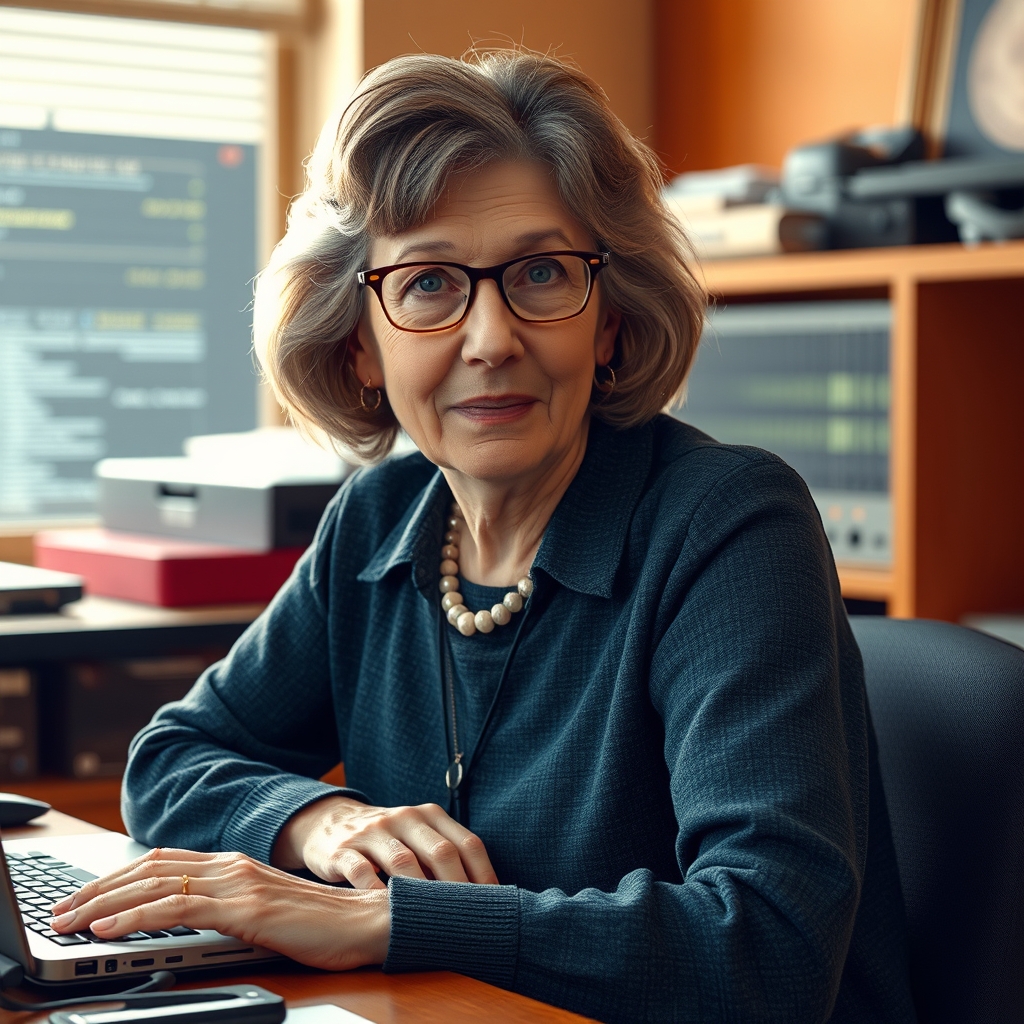
Margaret Hamilton Dies at 90: Apollo Software Pioneer Who Put Man on the Moon
Margaret Hamilton Dies at 90: Honoring the Woman Whose Code Guided Humanity to the Moon
The global technology and aerospace communities are pausing to remember a true giant. Margaret Hamilton, the trailblazing mathematician and computer programmer who led the software development team for NASA’s historic Apollo missions, has passed away at the age of 90. Her passing marks the end of an extraordinary life, but the systems she designed and the principles she established remain the bedrock of modern computing.
When humanity watched Neil Armstrong and Buzz Aldrin step onto the surface of the moon on July 20, 1969, the world celebrated astronauts, rocket designers, and mission controllers. Yet behind the scenes, running quietly beneath the lunar module’s instrument panels, was an invisible marvel. It was a pioneering suite of software conceived, built, and rigorously tested by Margaret Hamilton and her team at the Massachusetts Institute of Technology (MIT). Without her code, the Apollo 11 lunar module would have aborted its historic landing just minutes before touching down in the Sea of Tranquility.
Hamilton did not just write the programs that steered spaceships across the void. She invented an entire discipline. At a time when software was considered an afterthought, she fought for its dignity, famously popularizing the phrase “software engineering.” Today, as we look back on her long life and towering legacy, we see an innovator whose brilliance and foresight helped invent our digital reality.
From the Midwest to the Frontiers of Meteorology and MIT
Margaret Elaine Heafield was born on August 17, 1936, in Paoli, Indiana. From an early age, she exhibited a sharp, inquisitive mind and a love for mathematics. She attended Earlham College in Richmond, Indiana, earning a bachelor’s degree in mathematics with a minor in philosophy in 1958. Her study of philosophy helped shape her deep fascination with logic, truth values, and the formal structures of reasoning, qualities that would later prove crucial in the world of computer science.
In the late 1950s, Hamilton moved to Boston, Massachusetts. Her initial intention was to support her husband while he attended Harvard Law School, with plans to pursue a graduate degree in abstract mathematics later. However, the rapidly evolving computing world interrupted those plans in the best way possible.
She took a job at MIT working under Professor Edward N. Lorenz, one of the founding fathers of chaos theory. Hamilton taught herself programming from the ground up. In those days, universities did not offer degrees in computer science. There were no textbooks on software architecture, no Stack Overflow to search for answers, and no modern debugging suites. Programmers had to figure out how computers worked by writing machine instructions directly on paper, feeding punch cards into hulking mainframes, and troubleshooting by sheer intuition.
Hamilton excelled at the work. She wrote software to forecast weather conditions and simulate atmospheric behavior on the Royal McBee LGP-30 and the PDP-1 computers. Lorenz recognized her rare talent for understanding how small computational errors could ripple across complex systems, a lesson that would become the foundation of her approach to life-critical software.
The SAGE Project: Learning to Build Unbreakable Systems
Hamilton’s success with meteorology software led her to MIT’s Lincoln Laboratory, where she worked on the Semi-Automatic Ground Environment (SAGE) project. SAGE was an enormous Cold War military radar defense system designed to track enemy aircraft and coordinate air defenses across North America.
At Lincoln Lab, the engineers had a tradition of handing newcomers difficult, messy programs that no one else could make work. Hamilton was handed a famously stubborn program that was known for crashing and printing out sarcastic error messages in Greek and Latin whenever an engineer ran it. Instead of giving up, Hamilton dove deep into the code, solved the logic puzzles, and got the software to run smoothly. She was the first person to crack it.
Her ability to make complex software work reliably under unpredictable conditions caught the attention of NASA. The space agency had just awarded MIT’s Instrumentation Laboratory (later named the Charles Stark Draper Laboratory) the very first contract for the Apollo program: designing the guidance, navigation, and control systems for the spacecraft that would carry Americans to the moon.
Hamilton joined the Apollo project in its infancy. She started as a programmer and worked her way up through sheer technical mastery, eventually becoming the Director of the Software Engineering Division of the MIT Instrumentation Laboratory. She was responsible for directing the team that created the onboard flight software for both the Apollo Command Module and the Lunar Module.
Inventing the Discipline of Software Engineering
It is difficult to imagine today, but in the early 1960s, software was treated as second-class work. Space engineers focused almost entirely on hardware: rocket engines, titanium hulls, radar antennas, fuel tanks, and mechanical switches. The computer code was seen as a clerical task, something to be written at the very end simply to connect the physical components.
Hamilton recognized that this attitude was dangerous. She knew that software was not just an accessory; it was the brain of the spacecraft. If the software failed, the hardware was useless, and human lives would be lost.
To give software the respect and rigor it deserved, Hamilton began referring to her craft as “software engineering.” At first, her hardware-focused colleagues laughed at the term. They argued that engineering was about physical materials, stress testing, and tangible structures, not lines of code written on paper. But Hamilton stood firm.
She argued that software, like bridges or aircraft wings, required formal processes, systematic design, rigorous testing, quality control, and strict verification. Over time, the engineering community stopped laughing. As mission after mission proved that the Apollo software was exceptionally reliable, the term gained universal respect. Today, software engineering is one of the most vital professions on Earth, and it owes its name and foundational credibility to Margaret Hamilton.
The Impossible Hardware: Coding the Apollo Guidance Computer
The technical challenges facing Hamilton and her team were staggering. The Apollo Guidance Computer (AGC) was a revolutionary machine for its time, but by modern standards, its specifications were shockingly modest. The AGC had:
- Only about 72 kilobytes of permanent read-only memory (ROM).
- Roughly 4 kilobytes of random-access memory (RAM).
- A processor operating at a clock speed of around 1.024 megahertz.
To put that in perspective, a modern budget smartphone has millions of times more memory and computing power than the computer that guided Apollo astronauts across 240,000 miles of deep space. Every single byte was precious. There was zero room for bloated code or inefficient algorithms.
Furthermore, the software could not be stored on magnetic hard drives or flash memory chips, which did not exist in forms suitable for spaceflight. Instead, the code was literally woven by hand into “core rope memory.” Workers, many of them skilled textile seamstresses at the Raytheon factory, used needles to thread copper wires through magnetic metal rings. If a wire passed through a ring, the computer read it as a binary 1. If it bypassed the ring, it was a binary 0.
Because the factory workers were predominantly women, Apollo engineers affectionately nicknamed this medium “Little Old Lady” (LOL) memory. Once the wires were threaded and sealed, the code was permanent. It could not be changed remotely over the internet, and there was no way to push an emergency update. If Hamilton’s team made a mistake in the code, the entire physical core rope had to be rewoven by hand, costing weeks of valuable time.
The Asynchronous Executive: The Architecture That Saved Apollo 11
Hamilton’s greatest technical breakthrough was the concept of asynchronous executive software. In the 1960s, most computers executed tasks in a simple, rigid sequence: step one, step two, step three. If a step took too long or became stuck, the entire system would freeze or crash.
Hamilton understood that a spacecraft operating in real time could not afford to freeze. A spacecraft was dynamic. Radar signals arrived unpredictably, astronauts flipped switches, thrusters fired, and gyroscopes measured changes in orientation. Hamilton and her team designed a priority-based, multitasking operating system that was years ahead of its time.
Under this system, the computer continuously assigned priority ratings to every job. Critical tasks, like firing the descent engine to prevent a crash, received the highest priority. Non-essential tasks, like refreshing the digital displays for the crew or processing background telemetry, were given lower priority.
If the computer was overloaded with too much incoming data, Hamilton’s software did not crash. Instead, it engaged in what she called “graceful degradation.” It dropped the low-priority background jobs, freed up memory buffers, and concentrated every ounce of processing power on the tasks needed to keep the astronauts alive and landing safely.
Three Minutes to Touchdown: The 1202 and 1201 Alarms
Hamilton’s architecture faced its ultimate test on July 20, 1969. The Apollo 11 lunar module, nicknamed Eagle, was descending toward the cratered surface of the moon. Neil Armstrong and Buzz Aldrin were just three minutes away from touchdown when the computer suddenly flashed an ominous code: 1202.
Moments later, another alarm flashed: 1201.
Inside the cabin, the tension was immense. Neither Armstrong nor Aldrin knew exactly what the numbers meant. The alarms signaled an executive overflow. The computer was being flooded with more computational requests than its tiny memory could handle. If the computer crashed, the mission would end in disaster, either through an immediate emergency abort or a fatal collision with the lunar surface.
Back at Mission Control in Houston, 26-year-old guidance officer Steve Bales consulted his team and recalled Hamilton’s specifications. He confirmed that the alarms meant the computer was overloaded, but Hamilton’s software was successfully purging the low-priority tasks and keeping the descent engine under control. Flight Director Gene Kranz received the call: “We’re go on that alarm.”
What caused the overload? It was later discovered that the rendezvous radar switch had been set to the wrong position on the astronaut checklist. The radar was sending dozens of unnecessary scanning pulses per second to the computer, eating up fifteen percent of its precious capacity. Had the computer run conventional sequential software, it would have locked up completely. Instead, Hamilton’s priority-scheduling algorithms stepped in, ignored the unwanted radar pulses, kept the landing engine firing smoothly, and allowed Neil Armstrong to touch down safely.
When Armstrong announced, “The Eagle has landed,” humanity cheered. But inside MIT, Margaret Hamilton and her engineers breathed a sigh of immense relief. The invisible shield of software had held firm.
The Lauren Bug: Learning from Human Curiosity
One of the most famous stories of Hamilton’s career illustrates her deep commitment to human-factor design and defensive programming. Hamilton was a working mother at a time when that was relatively rare in high-level engineering. On weekends and late evenings, she often brought her young daughter, Lauren, to the MIT Instrumentation Lab.
While Hamilton was busy coding, Lauren liked to play astronaut in the Apollo flight simulator. One day, while flying a simulated mission, Lauren pressed a key on the Display and Keyboard unit (DSKY) that triggered a program called P01, the pre-launch program, while the simulated spacecraft was already in mid-flight.
The computer became confused, attempted to wipe the navigation data in preparation for a launch that had already happened, and crashed the simulated flight. Hamilton realized immediately that an astronaut could easily make the exact same mistake in space under stressful or sleep-deprived conditions.
She approached NASA leadership and asked to add defensive code to block the computer from executing the pre-launch program once the spacecraft was in flight. NASA managers initially rejected her request. They told her that astronauts were elite military test pilots who were trained never to make a mistake. They insisted that human error of that type was impossible.
Hamilton could not change the code without approval, so she added a note to the mission documentation: Do not select P01 during flight.
Sure enough, during the Apollo 8 mission around the moon at Christmas in 1968, astronaut Jim Lovell accidentally entered the P01 command while adjusting the navigation system. The computer wiped its memory, losing its orientation data. Fortunately, because Hamilton had documented the scenario, her team at MIT worked through the night to calculate and upload new coordinates, restoring the spacecraft’s navigational lock. After that incident, NASA gave Hamilton full permission to build whatever software safeguards she felt were necessary.
An Icon in a Stack of Paper
For decades, Hamilton was known primarily within aerospace and academic circles. That changed dramatically in the 2010s, thanks to the resurgence of a vintage photograph taken in 1969. In the picture, a smiling Margaret Hamilton stands proudly beside a stack of bound paper binders that reaches all the way to her chin.
Those binders contained the printed source code for the Apollo guidance software, thousands of pages of assembly code written by Hamilton and her MIT team. The photograph went viral on the internet, transforming Hamilton into a global symbol of women in STEM and an inspiration to a new generation of programmers.
The photo captured the sheer scale of the achievement. In an era before modern software development environments, version control systems like Git, or automated continuous integration, Hamilton’s team had managed, organized, and cross-referenced that massive body of logic by hand, achieving a zero-defect record during actual flight operations.
| Mission Phase | Key Software Innovation | Real-World Impact |
|---|---|---|
| Apollo Pre-Flight | Defensive validation and error checking | Prevented accidental astronaut command overrides. |
| Apollo 8 Lunar Orbit | Rapid navigational telemetry recovery | Allowed crew to safely reorient spacecraft after memory clearing. |
| Apollo 11 Landing | Priority-based asynchronous multitasking | Ignored radar overload, allowing lunar touchdown without aborting. |
| Skylab & Shuttle | Universal systems engineering principles | Laid ground rules for ultra-reliable aerospace software architectures. |
Entrepreneurship, USL, and Hamilton Technologies
After the Apollo program concluded, Hamilton did not rest on her laurels. She saw that the software industry outside of aerospace was struggling with what experts called the “software crisis.” Commercial programs were constantly arriving late, running over budget, and crashing due to basic design defects.
In 1976, Hamilton co-founded Higher Order Software (HOS) to develop techniques for building fault-tolerant software systems. Later, in 1986, she founded Hamilton Technologies in Cambridge, Massachusetts. There, she developed the Universal Systems Language (USL) and the Development Before the Fact paradigm.
Her central philosophy was simple yet profound: instead of letting developers write buggy code and then spending months trying to test and patch it afterward, systems should be designed using mathematically rigorous models that make it impossible to introduce bugs in the first place. Her work on automated code generation and formal system verification was decades ahead of its time, anticipating modern concepts of formal verification and model-driven engineering.
Overdue Recognition and the Presidential Medal of Freedom
For much of her life, Hamilton worked without seeking public fame. But in her later years, the world finally recognized the magnitude of her contributions.
In 2003, NASA honored her with the Exceptional Space Act Award for her technical and scientific contributions. The award recognized that the concepts of asynchronous executive software and error-recovery she created for Apollo were so robust that they became standard architecture across subsequent space projects, including Skylab and the Space Shuttle program.
The pinnacle of public recognition came in November 2016, when President Barack Obama awarded Margaret Hamilton the Presidential Medal of Freedom, the highest civilian honor in the United States. During the ceremony at the White House, President Obama praised her leadership, stating that her work represented the very best of American audacity and scientific curiosity. He noted that her code sent human beings into the heavens and created an entire industry that now powers the global economy.
She was also celebrated across popular culture. Lego created a minifigure in her likeness as part of the “Women of NASA” set, introducing millions of young children around the globe to the woman who coded the moon landing.
The Timeless Lessons Margaret Hamilton Leaves Behind
As we reflect on Margaret Hamilton’s passing at age 90, her life offers invaluable lessons that continue to guide programmers, engineers, and dreamers everywhere:
- Rigor is non-negotiable: Hamilton proved that software is not just an artistic sketch; it is a discipline that requires strict mathematical precision, deep testing, and thorough verification.
- Design for human fallibility: She recognized that humans make mistakes. Whether it was an astronaut flipping a switch in a crowded cockpit or a tired programmer missing a boundary case, she built systems that expected errors and recovered from them gracefully.
- Never accept artificial boundaries: When told that software was not real engineering, Hamilton did not back down. She championed her team, defended the importance of their work, and coined a title that millions of professionals proudly wear today.
- Curiosity is the mother of reliability: Her willingness to investigate obscure glitches, listen to simulator quirks, and ask “what if” saved lives and shaped the course of space exploration.
A Final Salute to a Pioneer of the Cosmos
Margaret Hamilton lived to see humanity enter a world that would be unrecognizable without the discipline she helped invent. Today, software runs our hospitals, guides our commercial airliners, coordinates our communications, and steers robotic rovers across the red plains of Mars. Every time a modern operating system prioritizes a critical task, suppresses a memory leak, or recovers from an unexpected hardware signal, it is carrying on the design principles that Margaret Hamilton proved half a century ago.
She approached computing not merely as a career, but as an adventure into the unknown. When NASA set out to achieve what many thought was impossible, they relied on a brilliant young woman from Indiana who had the courage to write the code that carried humanity off the Earth.
Margaret Hamilton has passed away at 90, but her legacy is immortal. It lives on in every computer science lecture hall, in every line of robust code written by modern software engineers, and in the quiet silver light of the moon, where her digital footprints will remain forever.


news via inbox
Nulla turp dis cursus. Integer liberos euismod pretium faucibua